Chopper
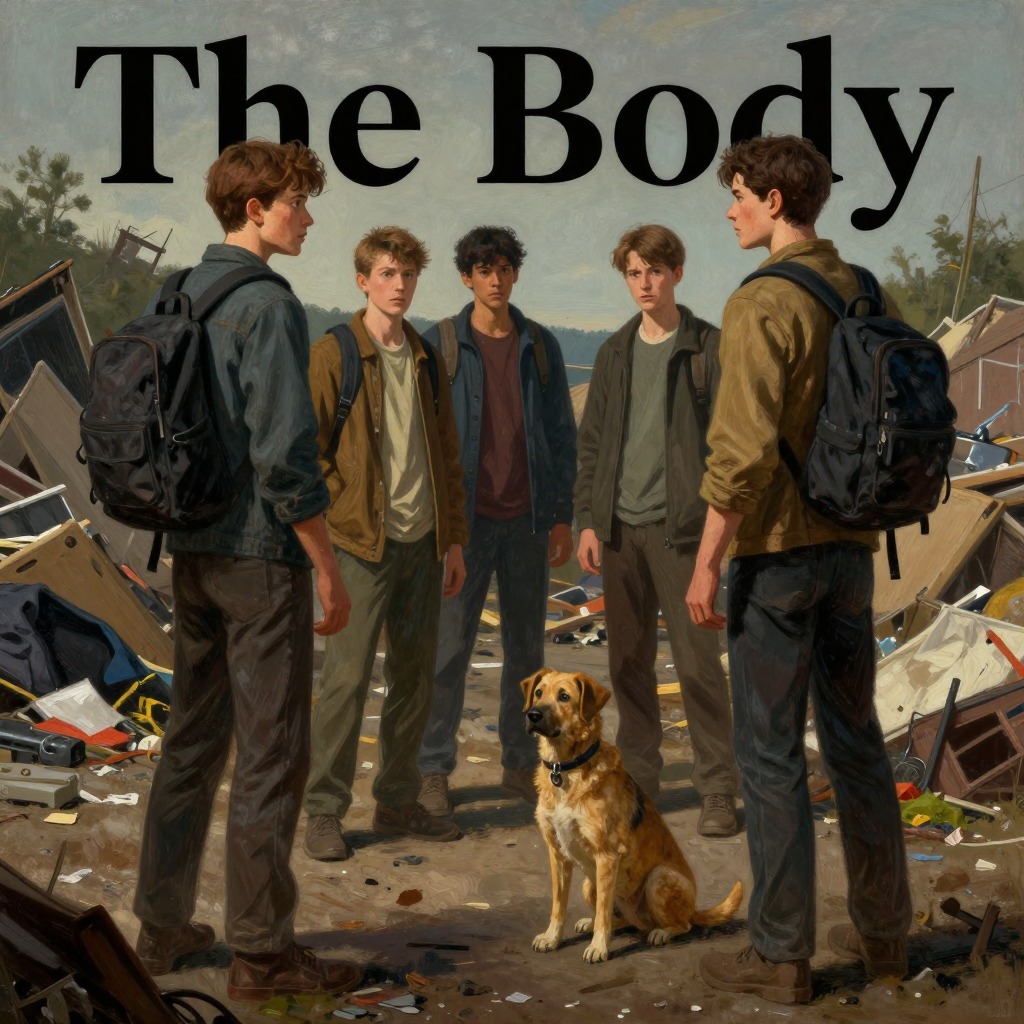
Chopper, the guard dog of the Castle Rock Dump, is one of the most feared and least seen animals in the town, a creature whose legendary ferocity far outstrips his actual capabilities. Owned by the dump-keeper Milo Pressman, Chopper exists at the center of a web of childhood myths that paint him as a monstrous, almost supernatural beast, making his eventual confrontation with the four boys a pivotal moment of comic anticlimax and unexpected pathos.
Legend and Reputation
The stories the children of Castle Rock whisper about Chopper are elaborate and terrifying. Some claim he is half German shepherd, others that he is mostly boxer, and a boy named Harry Horr insists Chopper is a Doberman pinscher whose vocal cords have been surgically removed so he can attack in complete silence. Still other kids maintain he is a maniacal Irish wolfhound fed a special diet of Gaines Meal and chicken blood, and that Milo Pressman does not dare take him out of his shack unless the dog is hooded like a hunting falcon. The most common and chilling legend is that Pressman has trained Chopper not just to sic, but to sic specific parts of the human anatomy. According to this lore, an unfortunate kid who illegally scales the dump fence might hear Milo cry, "Chopper! Sic! Hand!" and Chopper would grab that hand, ripping skin and tendons and powdering bones until told to quit. It is rumored that Chopper can take an ear, an eye, a foot, or a leg, and that a second offender would hear the dread cry, "Chopper! Sic! Balls!" and be made a soprano for life. These stories, passed among the town's children, transform Chopper from a mere dog into a figure of pure, surgical terror.
The Confrontation
The reality of Chopper is dramatically different from his legend. When Gordon Lachance, having run from Milo's shouted threats, throws himself over the dump's chain-link fence, Chopper hits the fence behind him and lets out a howl of mingled pain and disappointment. Gordon turns to see, instead of some huge hellhound with red, savage eyes and teeth jutting out like straight-pipes from a hotrod, a medium-sized black-and-white mongrel, yapping and jumping fruitlessly, going up on his back legs to paw the fence. Teddy Duchamp immediately begins to taunt the dog, strutting up and down in front of the fence, twiddling his glasses in one hand, and inciting Chopper to ever greater rage. He bumps his fanny against the chain-link, and Chopper lunges at it, always missing, doing nothing but racking out his nose, which begins to bleed. Teddy calls him by the grisly diminutive "Choppie," and the dog goes nuts, running in a big circle, yelping and barking and foaming. He launches himself straight at the security fence at what seems like thirty miles an hour, his lips stretched back from his teeth and his ears flying in the slipstream. The whole fence makes a low, musical sound as the chain-link is driven back against the posts, and Chopper performs a totally amazing reverse snap-roll, landing on his back with a solid thump that sends dust puffing up around him. He crawls off with his tongue hanging crookedly from the left side of his mouth, a defeated and pathetic figure.
Catalyst for Conflict
Chopper's failure becomes the immediate cause of a far more serious confrontation between Teddy and Milo Pressman. Enraged by his dog's humiliation, Milo himself goes almost berserk, his complexion darkening to a scary plum color. He identifies Teddy by name and threatens to beat his ass, but Teddy raves right back, calling him "fatass" and "lard-bucket." The conflict escalates when Milo, finding the loony button inside Teddy, calls Teddy's father a "loony" and says he is "up to Togus" because he "went fucking section eight." This strikes at the core of Teddy's identity and his fierce, protective love for his father, Norman Duchamp, a Normandy beach stormer now confined to the Togus VA hospital. Teddy throws himself at the fence to attack Milo, and only Gordon's intervention—grabbing Teddy by the loose seat of his jeans and pulling him off—prevents a fight that would have ended badly for the boy. Chopper, the failed monster, thus serves as the unwitting trigger for a raw, painful exposure of the wounds within Teddy's family.
Significance
Chopper functions as a powerful symbol of the vast difference between myth and reality that pervades the boys' journey. The town's elaborate legends about him are a form of collective storytelling that creates a shared, thrilling fear, much like the stories Gordon himself writes. Yet when the boys actually face him, the terror dissolves into absurd comedy. Chopper is not a hellhound but a clumsy, overmatched mongrel, and Milo Pressman, for all his bluster, is revealed as a fat, aging man locked inside the playground of his own dump, yelling for someone to come and let him out. The dog's anticlimactic defeat underscores a central theme of the book: that the monsters of childhood, whether real or imagined, are often far less frightening than the human cruelties and sorrows they mask.